
In short: Abwiz Bio’s antibody affinity maturation service (STEM) increases the binding affinity of an existing antibody lead — typically from the nanomolar into the picomolar range — while preserving its specificity, function, and developability.
Who it’s for: teams with a validated antibody whose potency, not its target, is the bottleneck.
What you receive: a panel of matured variants with measured affinity (KD), expression, and developability data. You keep full IP, with no downstream royalties on standard scope.
Documented results: affinity improvements up to 1,338×, reaching an apparent KD as low as 4.4 pM; a published anti-TNF (infliximab-class) example combined higher affinity with improved expression and reduced self-association.
Antibody Affinity Maturation — From nM to pM, with STEM™
Antibody affinity maturation services from Abwiz Bio take a parental antibody at nanomolar K_D and drive it into the picomolar range using STEM™ (STage Enhanced Maturation) — our multi-stage in vitro evolution platform that diversifies each CDR separately using human antibody amino acid frequencies, then recombines light and heavy chain libraries under stringent selection. We have documented affinity improvements exceeding 1,300-fold on a single program and have delivered a matured lead at 4.4 pM apparent K_D. Abwiz Bio is a San Diego antibody CRO that has been running discovery and engineering programs since 2012, and affinity maturation is one of the most reproducible workflows on the bench.
Free 30-minute call with the PhD scientist who would run the work · Initial feasibility assessment within two business days · NDA available before you disclose your target
The affinity decision: when affinity is the constraint, and when it is not
Affinity maturation is one of the most over-applied steps in modern antibody engineering. Before any sponsor commissions a campaign, the question to answer is whether functional affinity — the apparent K_D in the assay that mirrors the therapeutic mechanism — is actually the development-limiting variable. If it is, picomolar affinity is worth the time and cost. If it is not, the same investment is better spent on developability, isoform optimization, or epitope-resolution work.
Therapeutic potency and the receptor occupancy curve
The clearest case for affinity maturation is a therapeutic candidate where receptor occupancy at a tolerable clinical dose is insufficient to drive the pharmacodynamic effect. The relationship between K_D, free drug concentration, and receptor occupancy is governed by a saturable binding curve whose inflection point sits near the K_D itself. Pushing K_D down by one or two orders of magnitude shifts the entire dose-response curve to the left, allowing the same biological effect at a fraction of the systemic exposure. For oncology biologics dosed at the edge of the maximum tolerated dose, for ophthalmic drugs constrained by intravitreal volume, and for subcutaneous chronic-dose programs constrained by injection volume, an order of magnitude in K_D often translates directly into clinical feasibility.
Dose reduction, half-life, and the cost of goods
Picomolar affinity also matters when program economics depend on dose. A monoclonal antibody at multi-gram annual dose is materially more expensive to manufacture than one at sub-gram annual dose, and the difference flows through to cost of goods sold and to the realistic indication ceiling of the drug. Reducing the required dose by a factor of three to ten through affinity maturation can move a candidate from a niche oncology indication into a chronic autoimmune indication where the same biology has a larger commercial footprint. The same logic applies to antibody-drug conjugates, where a higher-affinity antibody delivers more payload per unit of administered drug.
Serum stability and functional half-life
Off-rate matters as much as on-rate for serum-dosed biologics. An antibody whose off-rate falls below roughly 1×10⁻⁵ s−1 behaves, on the timescale of a dosing interval, almost as if it does not come off at all, extending functional half-life beyond what FcRn recycling alone would predict. STEM™ maturation is biased toward off-rate selection in late stages precisely because off-rate drives durable receptor occupancy in vivo.
When not to mature
Affinity maturation is the wrong investment when the parental antibody is already at the functional ceiling of the target. A signaling antibody that reaches full receptor blockade at parental K_D will not gain function from a tighter K_D. A diagnostic capture antibody used at saturating concentration will not see analytical benefit. We will tell you on the scoping call when the answer is to skip maturation and invest in another axis of the molecule.
The STEM™ platform — STage Enhanced Maturation
STEM™ (STage Enhanced Maturation) is the in-house affinity maturation platform we have been refining at Abwiz Bio since the company was founded in 2012. It is not a single technique. It is a staged workflow built around one idea: separate the question of what each CDR can tolerate from the question of which combinations actually work together, and answer them in that order. The result is a maturation workflow that consistently delivers picomolar leads on amenable targets and that has produced the >1,300× improvement documented in our internal case file.
Stage 1 — per-CDR libraries and chain recombination
Stage 1 runs two steps back to back, contracted and scheduled as a single stage.
First, each of the six complementarity-determining regions is diversified individually. H1, H2, H3, L1, L2 and L3 each become their own library, so a substitution that helps in one CDR is not masked by a deleterious change elsewhere in the same molecule. The substitutions are not random: at every position we mutate toward the amino acids that human antibodies actually use at that position, using the observed frequency distribution as the design input. The searchable space collapses to something a library of practical size can cover properly, and the variants that survive are already human-like — so maturation does not quietly re-introduce the immunogenicity risk that humanization was meant to remove.
Second, the binders recovered from those per-CDR libraries are pooled and the light-chain and heavy-chain libraries are recombined against each other. Combinatorial LC–HC pairing generates variants that never existed in the individual libraries, because improvements found separately in different CDRs are now carried in the same antibody. Selection runs with negative selection against a polyspecificity reagent to drop sticky clones and a heat-treatment step to drop unstable ones, so developability is filtered during selection rather than discovered afterwards. Stage 1 runs about three months.
Stage 2 — full combination library
A note on naming: our published methods describe this workflow as three stages. The current commercial format contracts the first two into a single contracted, scheduled stage — the science and the selection sequence are unchanged.
Stage 2 takes the best light-chain and heavy-chain pairs coming out of Stage 1 and recombines them all against each other in a single full combination library, under the most stringent selection of the campaign and with heat treatment applied again.
This is the step that single-CDR methods cannot reproduce at all. Most of the binding energy in a real paratope comes from combinations of substitutions across several CDRs rather than from any one change, and those combinations only exist if you actually build them. Stage 2 is where the campaign converges on the recommended leads, and where a standard engagement delivers. It runs about two months.
Why staging beats single-method maturation
Random mutagenesis across the whole variable region generates broad diversity but wastes most of the library on substitutions no human antibody would carry, and it cannot separate the contribution of one CDR from another. Single-CDR walking focuses tightly but never builds the cross-CDR combinations that carry most of the binding energy. STEM™ separates the two problems: Stage 1 finds what each CDR tolerates on its own, Stage 2 builds the combinations. The individual techniques are public; what is proprietary is the amino acid frequency tables that drive the design, the diversification ratios per CDR, and the selection schedule that layers stringency, polyspecificity counter-selection and heat treatment onto the same panning workflow.
Integration with humanization and discovery
STEM™ was designed from the start to be applied either to a parental antibody or to a humanized lead. When a sponsor is running both antibody humanization and affinity maturation in the same program, the standard sequence is humanize first, run STEM™ on the recommended humanized lead, and select the matured variant on the human framework. This avoids the failure mode of maturing the parental antibody and losing the gain when the framework is replaced. For sponsors starting from a rabbit monoclonal — the most common upstream source — the path is described on the custom rabbit monoclonal antibody development page. The underlying library construction is described on the WizAmp™ library construction page, and the WizAmp™ library construction patent covers the upstream library tooling we use across discovery and maturation.
>1,300× improvement documented — what the number means
The headline number — affinity improvement exceeding 1,300-fold — comes from an internal program in which a parental rabbit monoclonal at low-nanomolar K_D was matured through the full STEM™ workflow and delivered a lead at single-digit picomolar K_D measured on independent biosensor platforms. The full case file is shared under non-disclosure with serious prospects on request. The summary below is what we are able to discuss in public.
A feline lead matured from 5.9 nM to 4.4 pM
Parental clone: a felinized monoclonal antibody in a client programme, with an apparent K_D of 5,890 pM (5.9 nM) at the start of the engagement.
Maturation programme: STEM™ with all six CDRs diversified as separate libraries, followed by combinatorial light-chain / heavy-chain recombination under stringent selection with polyspecificity counter-selection and heat treatment, then the full combination library in Stage 2.
Outcome: four engineered clones were delivered, improving in steps to 224 pM, 63 pM, 64 pM and 4.4 pM. The best clone represents a 1,338-fold improvement in apparent K_D over the parental. Binding was measured in-house by Octet (biolayer interferometry); the values above are apparent K_D from that platform.
What it does and does not show: this is one documented programme, not a guaranteed outcome. It is the largest fold-improvement in our case file, and it started from a parental antibody in the mid-nanomolar range — which is where the largest gains are available. A parental that is already a heavily evolved clone at low nanomolar will not have the same headroom. We will tell you which situation your programme is in on the scoping call.
The 1,300× figure is a documented observation, not a marketing promise. The realistic expectation on a new program is one to three orders of magnitude of K_D improvement, with the upper end available when the parental is naive to selection pressure and the antigen tolerates high-stringency off-rate selection. Where the parental is a heavily evolved clone, where the antigen is unstable on biosensor surfaces, or where epitope drift would compromise specificity, the realistic ceiling is usually one to two orders of magnitude — and we will say so on the scoping call.
Affinity is the easy part — developability is where campaigns fail
The usual objection to affinity maturation is not whether affinity improves. It is whether the molecule that comes back is still manufacturable. Tighter binders are routinely more self-associating, more aggregation-prone, and harder to express. A lead that gains affinity but fails developability screening has cost you time, not saved it.
So we ran our own platform against a molecule with a documented liability, and published what happened — including the part that did not work the first time.
The benchmark: infliximab
Infliximab is a mouse–human chimeric anti-TNFα IgG1, one of the most commercially successful therapeutic antibodies ever approved, and a molecule with well-documented reversible Fab–Fab self-association. We grafted its CDRs onto human germline acceptor frameworks (IGKV6-21 and IGHV3-72, selected by IgBLAST for identity and preservation of canonical loop structure), then ran STEM™ on the humanized scaffold.
What STEM™ did — and what it did not
STEM™ recovered and improved potency. The matured clone hInBG4 reached an IC50 of 42.0 ng/mL in a cell-based TNFα neutralization assay, against 96.8 ng/mL for chimeric infliximab and 166.1 ng/mL for the humanized parent. Polyspecificity stayed low.
But developability profiling showed that hInBG4 had inherited the self-association liability of its parent — an AC-SINS Δλmax of 9.00 nm, against 19.33 nm for infliximab itself.
That is precisely what developability screening is for. Using hInBG4 as the scaffold we built a panel of targeted CDR substitutions and profiled every one by AC-SINS, BVP ELISA, SE-HPLC and transient expression. Three clones cleared all four.
| Clone | TNFα neutralization IC50 (ng/mL) |
Self-association AC-SINS Δλmax (nm) |
Non-specificity BVP ELISA ratio |
|---|---|---|---|
| LW2Y | 34.5 | −1.67 | 1.5 |
| LW2YHR1K | 33.2 | 0.33 | 1.3 |
| LW2YR2S | 45.4 | −0.33 | 1.5 |
| hInBG4 (STEM™ output) | 42.0 | 9.00 | 2.3 |
| hInfliximab (humanized, pre-maturation) | 166.1 | −4.00 | 1.1 |
| Infliximab (chimeric parent) | 96.8 | 19.33 | 1.3 |
| Adalimumab (benchmark) | 167.0 | −1.33 | 1.6 |
LW2Y neutralizes TNFα 2.8× more potently than chimeric infliximab and 4.8× more potently than adalimumab, while self-associating less than either. SE-HPLC showed sharp, symmetrical monomer peaks where both infliximab and hInBG4 tailed. Transient expression in HEK293 rose from roughly 50 µg/mL for the humanized parent to 78–90 µg/mL for the engineered clones.
Potency up, self-association down, expression up — on the same molecule, verified on four orthogonal readouts.
Why developability sits inside the selection, not after it
Before every round of selection the phage library is heat-challenged and subtracted against a panel of polyspecificity reagents — baculovirus particles, dsDNA, ovalbumin, HSP90-Fc and KLH. Polyreactive and thermally fragile clones are removed before an affinity-driven selection can enrich them. That is why the BVP ratios above sit at 1.3–1.5, in line with infliximab and adalimumab themselves.
Self-association is the one liability that panel does not catch, which is exactly why we profile AC-SINS on purified IgG and engineer against it explicitly rather than assuming maturation will leave it alone.
Read the full case study — how the self-association was engineered out →
Entzminger PD, Entzminger KC, Fleming JK, Samadi A, Espinosa LY, Hiramoto Y, Okumura SCJ, Maruyama T. Engineering a pH-sensitive humanized infliximab with improved potency and developability using STEM™. bioRxiv, 19 August 2026. doi:10.64898/2026.08.18.745573. Preprint — not certified by peer review.
pH-dependent antigen release
An antibody that holds its antigen tightly in plasma but releases it in the acidified endosome can be recycled by FcRn and bind again. Where a programme is limited by target-mediated drug disposition, that behaviour can reduce antigen accumulation and, in some cases, dose and dosing frequency.
It is a design objective, not an accident — and an affinity number at pH 7.4 alone tells you nothing about it. The property has to be engineered into the CDRs and then verified kinetically at both pH values on the same sensor, with identical association conditions and only the dissociation buffer changed.
| Clone | KD (nM) at pH 7.4 | kdis (s−1) at pH 7.4 | kdis (s−1) at pH 5.8 | Fold acceleration |
|---|---|---|---|---|
| LW2Y | <0.001 | <1.0 × 10⁻⁷ | 1.80 × 10⁻⁴ | >1800 |
| LW2YR2S | 0.056 | 9.82 × 10⁻⁶ | 1.80 × 10⁻⁴ | 18.3 |
| LW2YHR1K | 0.539 | 9.49 × 10⁻⁵ | 1.77 × 10⁻⁴ | 1.9 |
| Adalimumab | 0.012 | 2.01 × 10⁻⁶ | 4.35 × 10⁻⁴ | 216 |
| hInfliximab | 0.752 | 1.60 × 10⁻⁴ | 2.82 × 10⁻⁴ | 1.8 |
| Infliximab | 1.009 | 2.19 × 10⁻⁴ | 1.51 × 10⁻⁴ | 0.69 |
LW2Y combines an apparent KD below 1 pM at pH 7.4 with a more than 1,800-fold faster off-rate at pH 5.8. Chimeric infliximab shows a ratio of 0.69 — no pH-dependent release at all. Adalimumab reaches 216-fold, but from a 12 pM starting affinity. Holding both properties at once is the hard part, and it is the part we engineer for.
All kinetics were measured in-house by biolayer interferometry on the Octet platform, with TNFα captured on streptavidin biosensors and association performed at pH 7.4. LW2Y’s off-rate at pH 7.4 fell below the assay’s reliable detection limit, so the acceleration is reported as a lower bound.
If your target is subject to target-mediated drug disposition, say so at scoping and we will build the pH-differential readout into the campaign from the start rather than discovering the behaviour afterwards.
Affinity maturation methods compared — STEM™ vs phage display and CDR walking
STEM™ is not the only way to run affinity maturation. Phage display affinity maturation, and CDR walking are all valid methods in the right hands, and each is the right answer for a subset of program types. The table below summarizes how the methods compare on the dimensions that usually drive method choice. The narrative beneath the table is the part that matters: when each method is the right call, and when it is the wrong one.
| Method | Library size | Selection pressure | Off-rate selection | Strongest when |
|---|---|---|---|---|
| STEM™ (staged in vitro) | Up to ~1 × 10¹⁰ cfu per stage | Progressive across stages | Native to late stages | Picomolar target, off-rate-driven |
| Unstaged phage display (single pass) | 10^9 – 10^11 | Constant per panning round | Possible with engineered protocols | Very large search space, on-rate bias |
| CDR walking (rational) | Hundreds – thousands per CDR | None — rational design | Measured per variant | Known structure, single CDR limit |
When STEM™ is the right answer
STEM™ is the right answer when the target K_D is picomolar, when off-rate is the kinetic parameter that matters most for downstream function, and when the parental antibody has multiple affinity-determining contacts across more than one CDR. Stage 1 establishes what each CDR tolerates on its own; Stage 2 then builds the cross-CDR combinations that close the last order of magnitude, which single-method approaches usually leave on the table. STEM™ is also the right call when the program needs to preserve specificity against close paralogs — the counter-screen schedule is built into the selection logic.
Why CDR walking falls short
CDR walking — rational single-CDR saturation mutagenesis with each variant measured individually — samples hundreds to a few thousand variants per CDR. That is three to six orders of magnitude below what a staged library screens, and it tests one CDR at a time. Most of the affinity gain in a real paratope comes from combinations of substitutions across several CDRs, and those combinations are invisible to a method that never puts them in the same molecule. The approach can deliver a modest improvement when a high-resolution co-crystal structure is in hand and a single CDR clearly dominates the interface. It will not reach a picomolar end-goal, and we do not recommend it when picomolar is the requirement. For sponsors comparing CROs on method choice, the CRO buyer’s checklist includes a section on affinity maturation method selection.
Maturation after humanization — recovering and exceeding parental affinity
The most common use of STEM™ in a therapeutic development program is not as a stand-alone maturation on the original parental clone — it is as the second half of a combined humanization-plus-maturation engagement. The sequence matters: humanize first, identify the recommended humanized lead, then run STEM™ on the humanized framework. This avoids the failure mode of maturing the parental clone, then losing the affinity gain when the framework is swapped for a human germline that does not support the same vernier-residue context.
The combined workflow has two operational benefits beyond the affinity number. First, matured leads inherit the developability filter the humanization workflow applies — predicted aggregation, deamidation, and isomerization motifs are flagged before maturation, so the diversification step does not generate matured leads that fail the same filter downstream. Second, matured leads are scored against the same immunogenicity prediction panel used in humanization, so any T-cell epitope introduced by a beneficial maturation mutation is caught at the panel-readout gate. The combined humanization-plus-maturation engagement is described in more detail on the antibody humanization service page.
Functional vs apparent affinity — picking the right assay
An affinity maturation campaign is only as good as the assay used to score it. The most common reason a maturation program looks like it succeeded on the bench and underwhelms in downstream function is that the scoring assay measured apparent affinity on a non-physiological format and the matured antibody gained on the assay without gaining on the function. Choosing the right assay is half of the maturation campaign, and the choice depends on what the antibody has to do in the downstream application.
BLI — biolayer interferometry for variant triage
Biolayer interferometry on Octet is what we run in house, and it is the platform behind every K_D figure quoted on this page. Throughput is high enough to triage variants through the selection rounds, sample volume is low, and it resolves on-rate and off-rate separately — which matters because the late selection rounds are biased toward off-rate.
We report these as apparent K_D and we say so deliberately. At single-digit picomolar the dissociation is slow enough that any biosensor is working near the edge of what it can resolve in a practical experiment, and a number quoted without that caveat should be treated with suspicion whoever is quoting it. Where a programme needs a solution-phase reference measurement or a second orthogonal platform, we arrange it through a partner laboratory and identify it as such in the report.
ELISA — functional confirmation, not affinity measurement
ELISA is a functional confirmation assay, not an affinity-measurement assay for matured leads in the picomolar range. The dynamic range does not extend low enough to discriminate variants below high-picomolar K_D. ELISA remains useful as a specificity counter-screen and as a sanity check that the matured lead binds antigen in a non-biosensor format.
Inside the STEM™ platform
How stage-enhanced maturation works, and what it has delivered across internal and client programs. Click any figure to view it full size.
STEM™ targets affinity, specificity, pH sensitivity, developability and expression
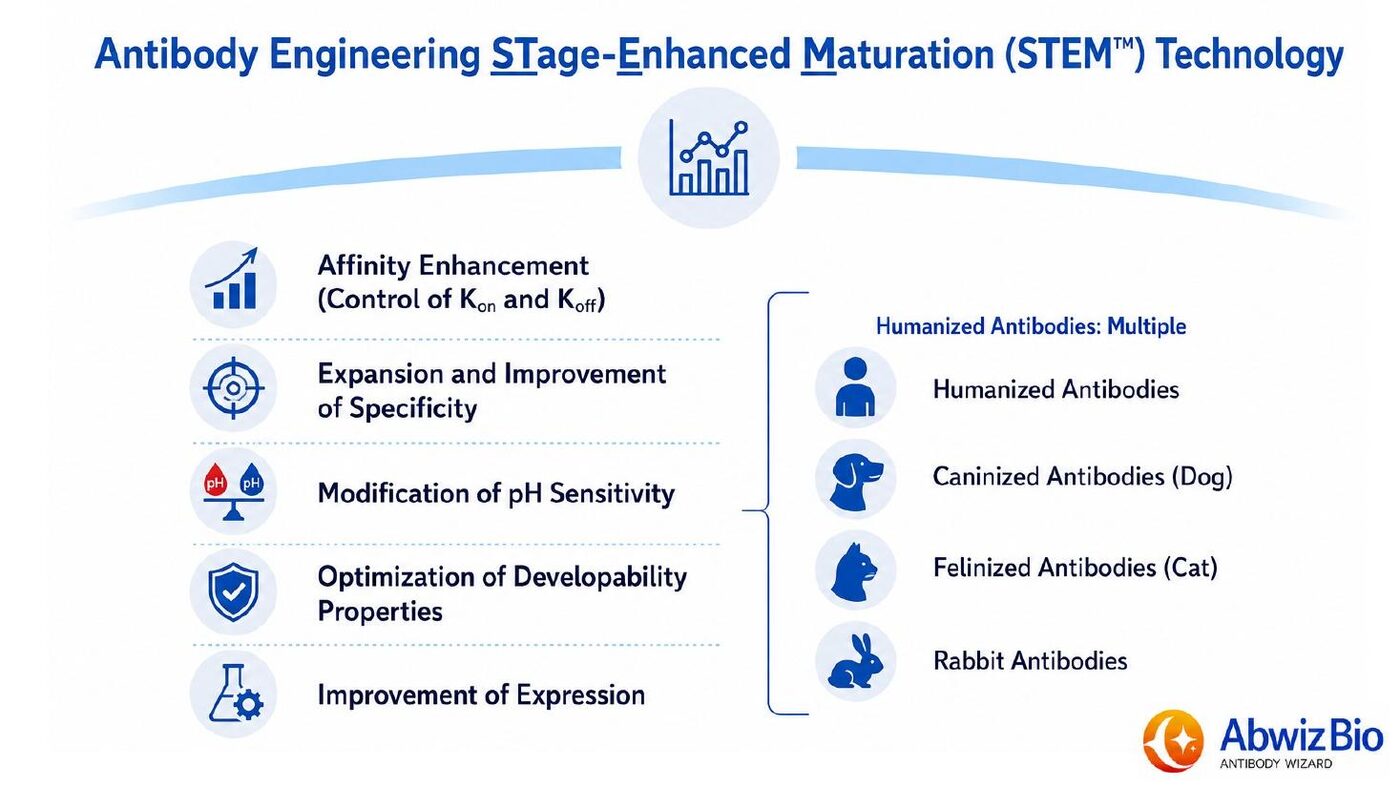
Stage-Enhanced Maturation is not limited to raising affinity. The same engine controls kon and koff independently, expands or narrows specificity, introduces pH-dependent binding, improves developability properties and raises expression. It is applied to humanized, caninized, felinized and rabbit antibodies.
Staged selection and combination guided by human antibody amino acid usage
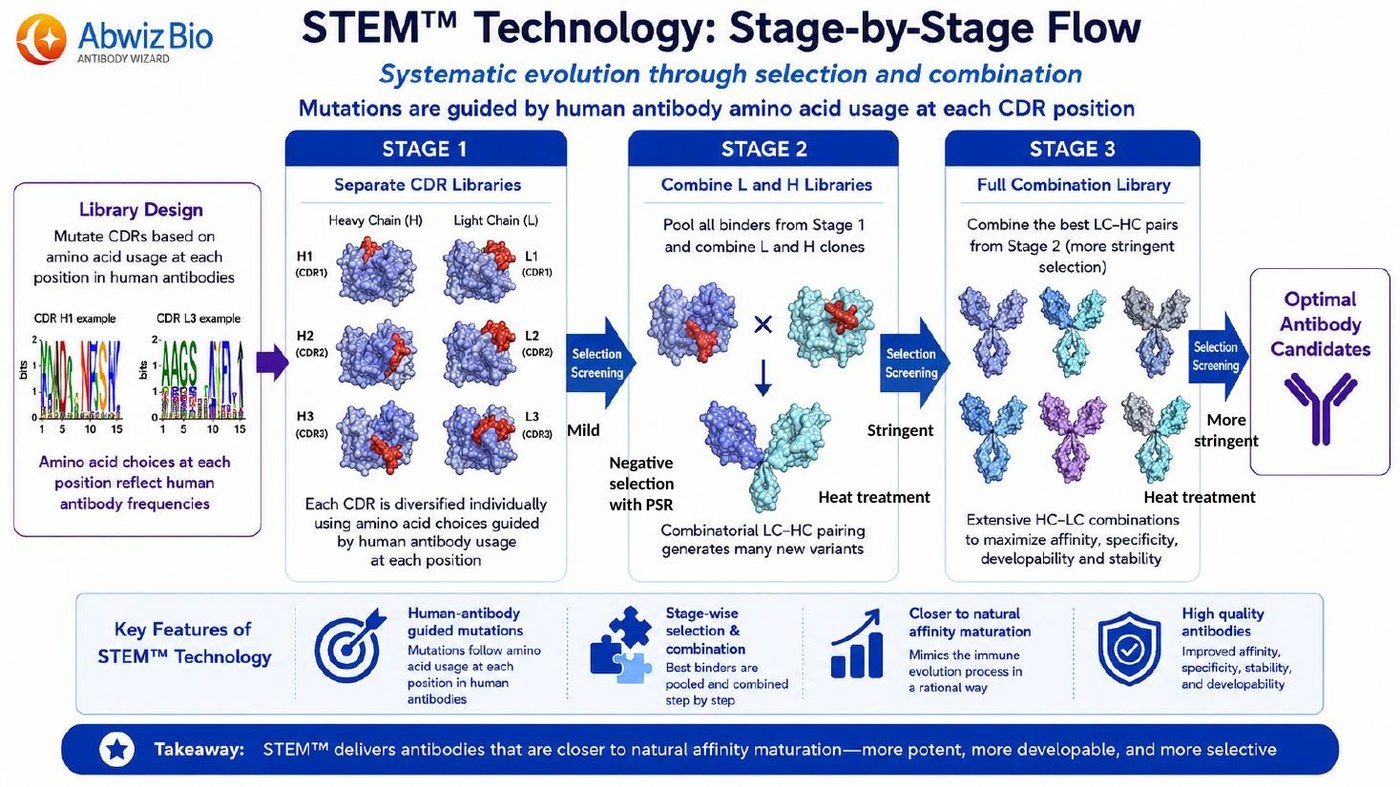
Mutations are chosen from the amino acid frequencies observed at each CDR position in human antibodies rather than by random mutagenesis. Stage 1 diversifies each of the six CDRs as a separate library and then recombines the light and heavy chain libraries, with negative selection against PSR and heat treatment in the same schedule. Stage 2 takes the best pairs and recombines them all in a full combination library under the most stringent selection of the campaign. The slide below shows the underlying method in three named steps; in a standard engagement the first two run together as Stage 1.
Rescue of difficult leads, kinetic tuning, and client affinity-engineering outcomes
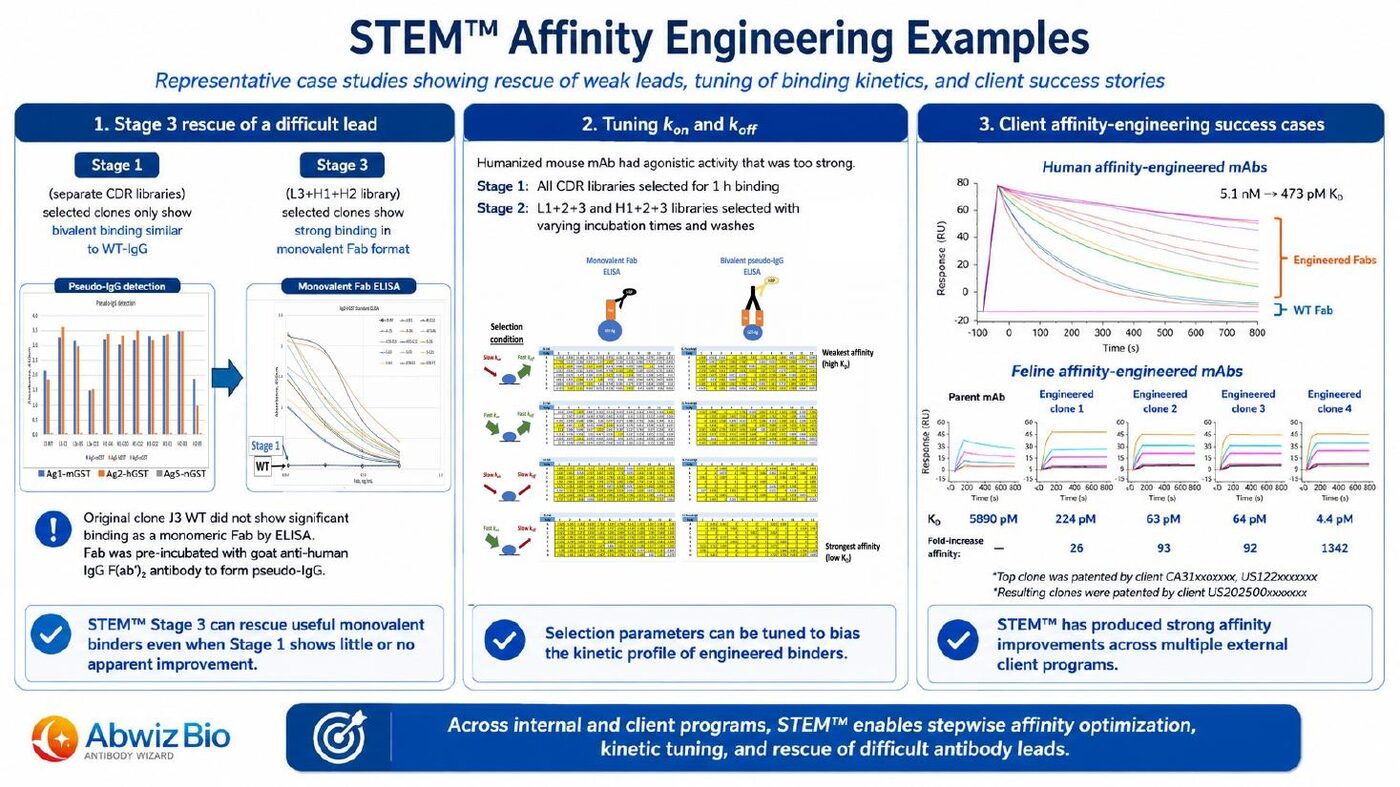
Full-combination selection recovered useful monovalent binders from a lead that showed no apparent improvement in the per-CDR libraries. Varying incubation times and washes biased the kinetic profile of engineered binders on demand. In client programs, engineered Fabs went from 5.1 nM to 473 pM KD, and a feline series improved from 5,890 pM to 4.4 pM — a 1,338-fold gain. Several resulting clones have been patented by the clients that own them.
Optimization improves potency, self-interaction and pH sensitivity together
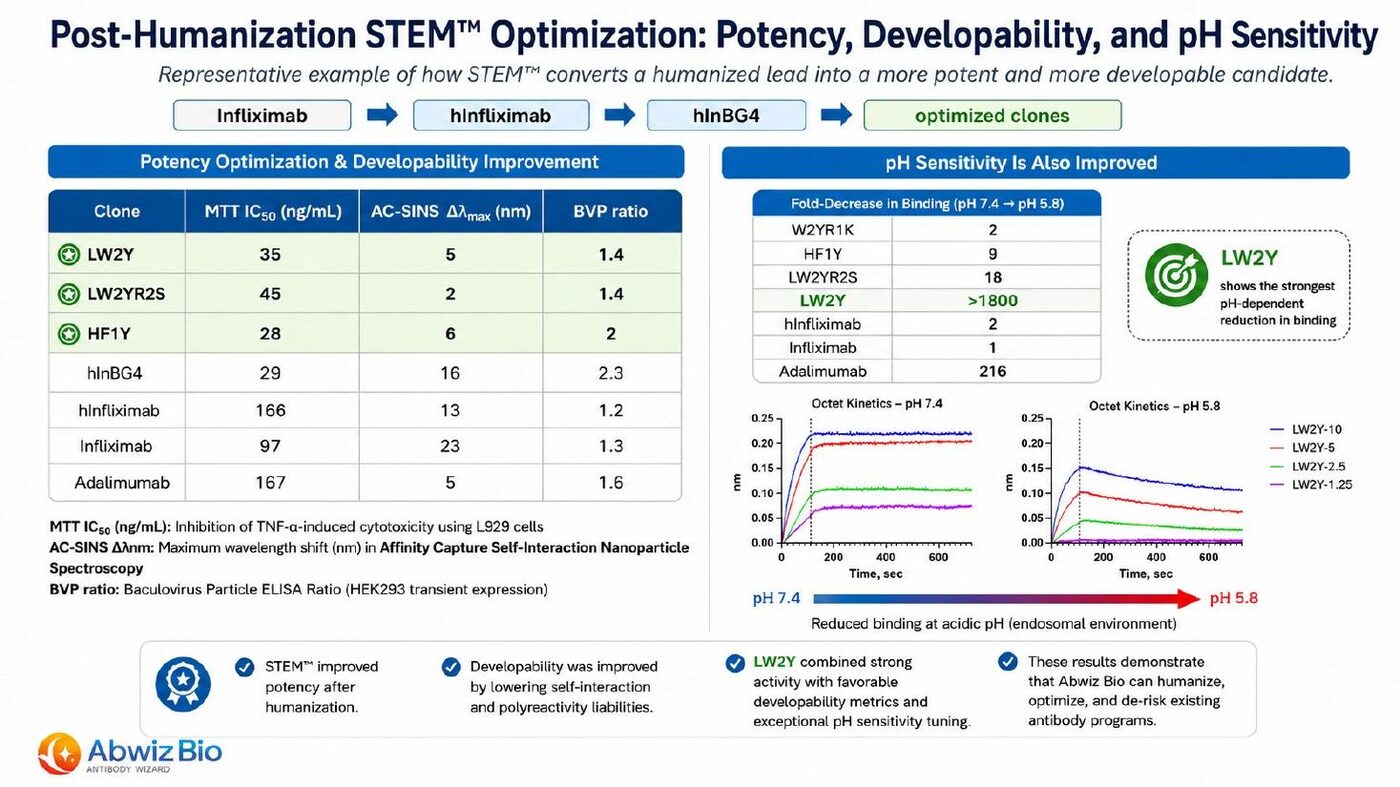
Applied to a humanized infliximab lead, STEM™ produced clones reaching 28–45 ng/mL MTT IC50 against 166 ng/mL for the humanized parent, while lowering AC-SINS shift and BVP ratio rather than trading them away. LW2Y dissociated more than 1,800-fold faster at pH 5.8 than at pH 7.4 by Octet kinetics — the signature of pH-dependent antigen release.
Timeline & deliverables
A stand-alone STEM™ affinity maturation engagement runs from about three months. Stage 1 on its own — six per-CDR libraries followed by light-chain / heavy-chain recombination — is a complete, separately contractable engagement at roughly three months, and sponsors who are satisfied with the leads it produces stop there. The full standard engagement, Stage 1 plus Stage 2, runs about five and a half months from kickoff: two weeks of scoping and library design, roughly three months for Stage 1, and roughly two months for Stage 2. The timeline depends on how many CDR positions are opened up in the library design, the number of selection rounds each stage needs, and how much functional characterization the sponsor wants on the delivered leads. The chart below is the standard engagement; combined humanization-plus-maturation engagements add the humanization phase in front of it and are described on the humanization service page.
Weeks 1–2 — scoping & library design
Scoping call with the lead scientist, parental antibody confirmation, structural model or crystal structure review where one exists, and the per-CDR library design: which positions to diversify and, at each position, which amino acids to draw on from the human antibody frequency distribution. Sign-off gate before any wet-lab work begins.
Months 1–3 — Stage 1
Six separate CDR libraries are built and taken through display selection, then the light-chain and heavy-chain libraries are recombined against each other. Negative selection against a polyspecificity reagent and a heat-treatment step run in the same schedule. Sequencing and enrichment data are shared as the rounds complete.
Months 4–5 — Stage 2
The best light-chain and heavy-chain pairs from Stage 1 are recombined into a single full combination library and taken through the most stringent selection of the campaign, with heat treatment applied again. This is where the cross-CDR combinations that carry most of the affinity gain are built and tested.
Final weeks — lead selection & deliverables
Recombinant expression of the matured leads, final K_D confirmation in-house by Octet, specificity counter-screen, and the deliverables package: sequences, kinetic data, functional data and the maturation rationale memo. Sponsors normally take the leads forward from here.
Standard deliverables package
- 5 to 10 matured leads with full VH and VL sequences in customer-preferred annotation (Kabat, IMGT, or both)
- Per-lead K_D measured in-house by Octet (biolayer interferometry), with full on-rate and off-rate decomposition
- Per-lead on-rate and off-rate decomposition for kinetic comparison against parental
- Specificity data against a customer-specified counter-screen panel (paralog, ortholog, or related antigen panel)
- Functional data in a customer-specified format (cell-based binding, competition, or activity assay) when scope-included
- Maturation rationale memo — library design, selection schedule, consensus mutation map, and the rationale for the recommended lead
- Sequences delivered ready for downstream humanization if not already humanized
IP & commercial terms
Most affinity maturation engagements are run on a fee-for-service basis with delivery of sequences and characterization data to the sponsor on completion. At standard scope, engagements are fee-for-service and carry no downstream royalty: you own the matured sequences outright. The specific assignment of rights to the matured sequences, the parental antibody, and any background platform inputs is documented in the master service agreement signed before kickoff, and the lead scientist will walk through the relevant terms on the scoping call.
For sponsors who need a non-standard commercial structure — for example, milestone-and-royalty terms in exchange for a reduced upfront fee, or a co-development structure with shared rights on an internal target — we can scope an alternate arrangement. The starting point for those conversations is the standard engagement above.
For peer-reviewed work that documents the underlying platform technology, see the publications page.
Frequently asked questions about antibody affinity maturation
What affinity improvement is realistic on a typical program?
The realistic expectation is one to three orders of magnitude of K_D improvement, with the upper end available when the parental antibody is naive to selection pressure and the antigen tolerates high-stringency off-rate selection. Our documented case file includes a 1,338-fold improvement and a delivered apparent K_D of 4.4 pM. On programs where the parental is already a heavily evolved clone or where the antigen is unstable on biosensor surfaces, the realistic ceiling is lower — usually one to two orders of magnitude.
Can STEM™ be applied to a humanized antibody?
Yes — in fact, this is the most common application. The recommended sequence is to humanize first, identify the lead humanized variant, then run STEM™ on the human framework background. This avoids the failure mode of maturing the parental and losing the gain on framework swap. The combined workflow is the basis for the 15-out-of-15 humanization success record on the platform.
How do you decide which mutations to try?
We do not mutate at random. For every position in every CDR we look at which amino acids human antibodies actually use at that position and how often, and we build the library toward that distribution. The searchable space collapses to something a library of practical size can cover properly, and the variants that survive are already human-like — so maturation does not quietly re-introduce the immunogenicity risk that humanization was meant to remove. Stage 1 applies this to each of the six CDRs separately; Stage 2 then recombines the light and heavy chain winners so that cross-CDR combinations are actually built and tested.
What display format do you use for affinity maturation?
We run phage display. The selection schedule — how the antigen concentration and wash stringency change from stage to stage — is what makes STEM™ staged, not the display format.
How do you prevent specificity drift during maturation?
Counter-screen against paralogs and related antigens is built into the staged selection schedule, not bolted on at the end. Late selection rounds include negative selection against the counter-screen panel, and the recommended matured leads are confirmed by competition binding against the parental clone to verify retained epitope. Specificity drift is the failure mode that an undisciplined maturation campaign generates and the one we explicitly design against.
What is picomolar antibody affinity and why does it matter?
Picomolar antibody affinity means an equilibrium dissociation constant (K_D) in the 1 to 999 pM range — three orders of magnitude tighter than nanomolar. It matters because the apparent K_D sets the inflection point of the receptor occupancy curve, which determines the dose required to drive a pharmacodynamic effect in vivo. Picomolar affinity moves a candidate from the dose-limited regime into the regime where serum stability and FcRn-mediated half-life dominate, which is generally the regime where therapeutic biologics succeed.
How do you measure final K_D on a matured lead?
Final K_D on the recommended lead is measured in-house by Octet (biolayer interferometry) with full on-rate and off-rate kinetics. Where a program calls for an orthogonal platform or solution-phase confirmation by KinExA, we arrange it through a partner lab and say so in the report. ELISA is used as a specificity counter-screen, not as an affinity-measurement assay in the picomolar range.
Do you offer in vitro affinity maturation without prior discovery work?
Yes. STEM™ is offered as a stand-alone engagement on a parental antibody from any source — hybridoma, phage display, single B-cell, or transgenic. Sponsors who want upstream discovery in the same engagement are pointed at the custom rabbit monoclonal antibody development service.
Scope your affinity maturation campaign with the lead scientist
STEM™ engagements start with a scoping call where the lead scientist who will run your program will discuss the parental antibody, the target K_D, the assay format, and the realistic ceiling for your campaign. The conversation is free, vendor-neutral on method, and ends with a written scope you can take to procurement.
Free 30-minute call with the PhD scientist who would run the work · Initial feasibility assessment within two business days · NDA available before you disclose your target
Related resources on Abwiz Bio
- Our technology platform overview — rabbit phage display, WizAmp™ library construction, STEM™ affinity maturation
- Antibody humanization service — the upstream engineering step most commonly paired with affinity maturation
- Custom rabbit monoclonal antibody development — the upstream discovery service that feeds parental clones into the STEM™ maturation workflow
- WizAmp™ library construction patent (US 9,890,414) — the patented library technology that backs upstream library construction
- Publications and case studies — peer-reviewed work documenting the discovery and engineering platform
- CRO Buyer’s Checklist (PDF) — a vendor-neutral scoring framework for evaluating affinity maturation and discovery CROs
- Email a scientist — direct technical scoping with the PhD who will run your program
Antibody affinity maturation: frequently asked questions
How much can you improve antibody affinity?
Documented improvements reach up to 1,338×, giving an apparent KD as low as 4.4 pM. STEM uses staged, human-framework-guided in vitro evolution, so affinity is gained in defined steps rather than a single round.
Will affinity maturation hurt developability or expression?
No. The process measures expression, self-association, and other developability properties alongside affinity, so variants are selected to improve binding without degrading manufacturability. In one published anti-TNF (infliximab-class) example, affinity, expression, and self-association all improved together.
How long does antibody affinity maturation take?
The first stage runs about three months; a full campaign runs to roughly five and a half months, depending on scope and the number of stages.
Who owns the resulting antibody, and are there royalties?
The client retains full ownership of the antibody and all data. Standard-scope engagements carry no downstream royalties.
What do you need to start — a sequence or a hybridoma?
An antibody sequence is enough to begin; a parental clone or hybridoma is not required. Existing affinity, expression, and functional data on the parental antibody help set targets.