
Antibody Humanization Service — Mouse to Human, 15 for 15
Humanize a mouse, rat, rabbit, or camelid monoclonal antibody for therapeutic development without surrendering affinity. Abwiz Bio is a San Diego antibody CRO that has delivered humanization on every campaign run since 2012 with retained binding on the human framework — 15 successful humanizations out of 15 attempted — and picomolar leads when STEM™ affinity maturation is layered on top. Our CDR grafting workflow combines structure-aware framework selection, vernier-residue handling, in silico immunogenicity prediction, and a developability filter before sequence release.
Free 30-minute call with the PhD scientist who would run the work · Initial feasibility assessment within two business days · NDA available before you disclose your target
The humanization decision: when, why, and at what risk
Humanization is a sequence-engineering decision that determines whether a candidate antibody can survive contact with a human immune system long enough to do its therapeutic job. Getting it wrong is expensive in two directions: a humanized clone that loses affinity will fail in efficacy, and a clone that retains affinity but still triggers anti-drug antibodies (ADAs) will fail in the clinic. Both failure modes are recoverable upstream and almost impossible to recover after IND filing — which is why sponsors increasingly treat humanization as a specialist service.
When to humanize
The default trigger is a therapeutic intent. Any non-human antibody intended for repeated systemic dosing in humans — oncology, autoimmunity, infectious disease, ophthalmology — needs humanization in order to meet the immunogenicity bar that regulators expect. The classical mouse-derived clinical antibody is now a regulatory anachronism: the published incidence of human anti-mouse antibody (HAMA) responses on murine therapeutics is high enough that no modern sponsor would advance a fully murine sequence into a multidose human trial. Humanization is also the right call for chronic-dose ophthalmic biologics where local exposure still drives detectable ADAs over years of repeat administration.
For diagnostic and research antibodies the decision is more nuanced. An in vitro diagnostic reagent generally does not need humanization — the parental sequence does the analytical job. A companion diagnostic used for in vivo imaging in patients is closer to a therapeutic and is usually humanized to match it. Research tools for in vitro biology rarely need humanization, but tools intended for translational work in human tissue or humanized-mouse models can benefit from it.
The risk of immunogenicity in clinical use
Immunogenicity manifests in three ways that all matter to a development program. Neutralizing ADAs blunt efficacy by clearing the drug or blocking the paratope before it reaches its target. Non-neutralizing ADAs alter pharmacokinetics, sometimes shortening half-life enough to make a tolerable dose subtherapeutic. And occasionally an ADA response generates infusion reactions or, in rare cases, cross-reacts with an endogenous protein. Humanization mitigates all three categories by reducing the number of non-self peptide sequences that human T cells and B cells can recognize. It does not eliminate immunogenicity — fully human antibodies still raise ADAs at meaningful rates — but it shifts the risk distribution toward an acceptable clinical profile.
Humanization in the context of IND filing
For an investigational new drug filing on a biologic, the humanization story is one of the first things a reviewer reads. Regulators expect a clear description of the framework selection logic, the back-mutation rationale, and the in silico and in vitro immunogenicity assessment. They expect to see the affinity comparison between parental and humanized leads and a justification for the chosen variant. A humanization program executed by a CRO that treats it as a checkbox can deliver sequences that work in the lab but generate questions during IND review. The work we ship is designed to defend itself in front of regulators — including the framework selection memo, the back-mutation map, and the developability dossier that sponsors fold directly into their Module 3 narrative.
Our humanization process — four phases, transparent at every gate
Our humanization workflow is the same one we use on our internal discovery programs and on the campaigns we deliver to therapeutic sponsors. The four-phase structure below is designed to surface risk early. Each gate has explicit deliverables and a go/no-go decision point that the sponsor signs off on before we move to the next phase.
Parental sequencing & structural model
We sequence the parental VH and VL from hybridoma RNA or your supplied plasmid, confirm authenticity by mass spectrometry of the parental IgG where available, and build a homology model of the Fv. The model identifies CDR boundaries by both Kabat and IMGT, flags vernier residues, and locates any framework positions that contact the CDRs.
Human framework selection
We select the closest matching human germline framework for VH and VL using a sequence-similarity scoring on the framework regions only. For sponsors who require it, we run the framework selection against a panel of accepted human germlines (IGHV1, IGHV3, IGKV1, IGKV3, IGLV1, IGLV3) and design parallel variants on multiple frameworks so the in vitro screen, not the in silico prediction alone, picks the winner.
CDR grafting & back-mutation
The parental CDRs are grafted onto the selected human framework. Vernier-zone residues and framework residues identified by the homology model as CDR-supporting are evaluated for back-mutation. The output is a small panel of 5 to 10 humanized variants spanning a range of back-mutation aggressiveness from minimal (most human, possible affinity drop) to conservative (more parental, lower risk of binding loss).
Developability & immunogenicity filter
Each humanized variant is passed through an in silico developability filter (predicted aggregation hotspots, unpaired cysteines, deamidation and isomerization motifs in the CDRs, glycosylation sites) and an in silico immunogenicity prediction (T-cell epitope scoring against a panel of HLA-DR alleles). Variants that fail either filter are flagged and either repaired or dropped before expression.
CDR grafting strategy — Kabat versus IMGT, and why it matters
The two dominant CDR definitions — Kabat and IMGT — differ at the boundary residues, particularly in CDR-H1 and CDR-H2. A Kabat-based graft will pull in framework residues that an IMGT-based graft will treat as CDR, and vice versa. On most antibodies the difference is cosmetic. On a small but meaningful fraction of programs, the choice of CDR scheme is the difference between a humanized clone that retains affinity and one that loses it by a factor of three to ten. Our default is to run the homology model and decide on a per-program basis which boundary residues belong in the graft — not to apply one scheme dogmatically. This is one of the per-program judgment calls that distinguishes a specialist humanization workflow from a templated one.
Vernier residues and framework-CDR contacts
The vernier zone — framework residues that pack against the CDRs and tune their conformation — is the single most important determinant of whether a humanized clone retains parental binding. Wholesale replacement of these residues with the human germline equivalents is the most common reason for affinity loss on humanization. Our default position is to retain the parental vernier residues in the first humanized variant, then progressively human-ize them in subsequent variants of the same panel, so the in vitro binding data tell us which residues can be moved without cost.
In silico immunogenicity prediction
For every humanized variant we run T-cell epitope prediction across a panel of common HLA-DR alleles. The output is a per-residue immunogenicity score that identifies any CDR or junction sequence that is predicted to present strongly on MHC class II. Predicted hotspots inside the CDRs are evaluated for conservative substitution — we will not move a residue that the structural model says is paratope-critical — but the prediction allows the sponsor to make an eyes-open call about which variants carry the lowest predicted ADA risk before the in vitro work begins.
Site-specific back-mutation strategy
Back-mutation is not a single decision; it is a panel-design decision. We design the humanized panel so that the most aggressive (fully human framework) variant and the most conservative (parental-vernier) variant are both expressed and tested. The variants between them sample specific back-mutation combinations identified by the homology model. The panel design is documented in a back-mutation map so the sponsor can see exactly which residues were moved in each variant and why. When the binding data come back from the panel, the choice of lead is data-driven, not an in silico guess.
What “15 for 15” actually means
The number gets quoted as a headline. It deserves the context behind it. Since we started running humanization campaigns at Abwiz, we have delivered 15 humanization projects to therapeutic and translational sponsors. On all 15, the humanized panel contained at least one variant that retained at least 80% of the parental antibody’s affinity in the same binding assay used to characterize the parental clone. Each panel typically contained 5 to 10 humanized clones, so the within-panel retention rate is higher than a single-clone-per-program number would suggest — what 15-for-15 captures is the rate at which the workflow produces a usable humanized lead in the first design pass, not a one-shot binding match.
The single-pass success has a structural reason. We design the panel to span back-mutation aggressiveness on purpose, so even when the most-human variant loses affinity, a more conservative variant in the same panel typically holds it. The trade-off the sponsor then weighs is human-ness against affinity retention on a per-variant basis, with the immunogenicity prediction informing the choice. On most programs the lead variant is closer to the conservative end of the panel; on a meaningful minority the lead is fully human-framework and the residue analysis explained, post-hoc, why the CDRs tolerated the graft cleanly.
The 15-for-15 number is also the reason we do not promise “guaranteed” humanization on every conceivable target. There are antibodies where the parental affinity is driven heavily by framework contacts — rare, but real — and on those we will tell the sponsor in scoping that a humanization-plus-STEM™ combined workflow is the right starting plan, not pure humanization alone.
STEM™ affinity maturation after humanization — when the panel needs a boost
A humanized variant that retains 80% of parental affinity is a clinical asset on most programs. But there are programs where the parental affinity is the floor, not the ceiling — where the sponsor needs picomolar binding, or where a competitor antibody has set a higher affinity benchmark. In that setting, humanization plus STEM™ (STage-Enhanced Maturation) affinity maturation runs as a combined workflow: humanize first, then mature the best humanized variant on the human framework background. The maturation work happens on the sequence the sponsor will actually file, not on the parental rabbit or mouse that will be discarded.
STEM™ diversifies the CDRs in focused libraries rather than running random mutagenesis. At each selected position the substitutions are drawn from the amino acids that human antibodies actually use at that position, weighted by their observed positional frequency, so maturation pushes the sequence further toward a human-like profile rather than away from one. The libraries are built in stages — each CDR on its own first, then recombined — and every round is heat-challenged and subtracted against a panel of polyspecificity reagents before selection, so thermally fragile and polyreactive clones are removed before affinity-driven selection can enrich them. On delivered maturation programs we have documented affinity improvements exceeding 1,300-fold, with the tightest delivered lead at 4.4 pM apparent KD measured in-house by Octet. Those numbers are the maximum performance from the platform on targets where deep paratope engagement was possible — not a per-program guarantee.
The combined humanization-plus-STEM™ engagement is typically the right call for therapeutic candidates where the parental antibody is functionally adequate but not best-in-class, for programs where the published competitor affinity has already been disclosed and the sponsor needs to clear it, and for targets where receptor density is low and high affinity is required to drive a meaningful pharmacological effect.
Case patterns we have solved — species, format, difficulty
The humanization workflow is the same across species of origin, but the per-program design choices shift based on the parental sequence. The four patterns below come up most often.
Rabbit monoclonal antibody humanization
The most common humanization engagement at Abwiz is the conversion of a rabbit monoclonal antibody — often one we discovered for the sponsor in an earlier phase — onto a human IgG1 or IgG4 framework. Rabbit CDRs frequently differ from human in length, particularly CDR-L3 and CDR-H3, and the rabbit framework contains residues at canonical-structure positions that do not appear in human germlines. The grafting strategy adapts to the per-program features of the rabbit Fv: where CDR-H3 length is unusual, the framework is selected for compatible canonical-structure support; where CDR-L3 carries a non-canonical residue, the back-mutation panel includes a vernier-supported variant that retains the parental conformation. The combination of rabbit-discovery and humanization on one platform reduces the handoff risk between phases. See the related custom rabbit monoclonal antibody development service for the upstream discovery workflow.
Mouse monoclonal antibody humanization (including legacy programs)
Sponsors regularly bring us mouse monoclonals from legacy hybridoma programs — sometimes decades old, sometimes from an internal program that was paused and is now being revived for clinical development. The humanization is structurally straightforward because the mouse-human framework similarity is high, but the per-program risk is in the supporting documentation: the parental sequence has to be re-confirmed, the hybridoma re-sequenced, and the binding data re-baselined before humanization can begin. We routinely deliver the full re-baseline as the first phase of a legacy humanization engagement so the downstream comparison to the humanized variant is on a known footing.
Camelid single-domain antibody (VHH / nanobody) humanization
Camelid sdAbs are an increasingly common starting point for therapeutic programs because of their stability, expression, and ability to access cryptic epitopes. Humanization of a VHH targets the four hallmark camelid framework residues (positions 37, 44, 45, 47 in Kabat) that distinguish camelid from human VH and that are critical for solubility of the single-domain format. The humanization preserves the CDRs and the canonical-structure determinants while moving the hallmark residues toward the human IGHV3 germline. The risk to manage is the trade-off between solubility (favors retaining the camelid hallmarks) and human-ness (favors moving them); the back-mutation panel is designed to surface that trade-off in the in vitro screen rather than guess at it.
Difficult CDRs — long CDR-H3, glycosylated CDRs, charge clusters
Some antibodies carry CDR features that demand specific handling. A long CDR-H3 (greater than 18 residues by Kabat) requires a framework with compatible canonical-structure support and may need vernier residues retained to stabilize the loop conformation. A glycosylated CDR — usually an N-linked site that the sponsor either wants to keep or remove — is engineered explicitly in the humanized panel so the in vitro data show whether removal is tolerated. CDRs with strong charge clusters can have isoelectric-point-driven aggregation behavior that the developability filter surfaces before the molecule reaches expression. None of these features make humanization impossible; they all change the per-program design.
Humanization data
Track record and worked examples from Abwiz Bio humanization programs. Click any figure to view it full size.
Humanization approach, species covered and track record
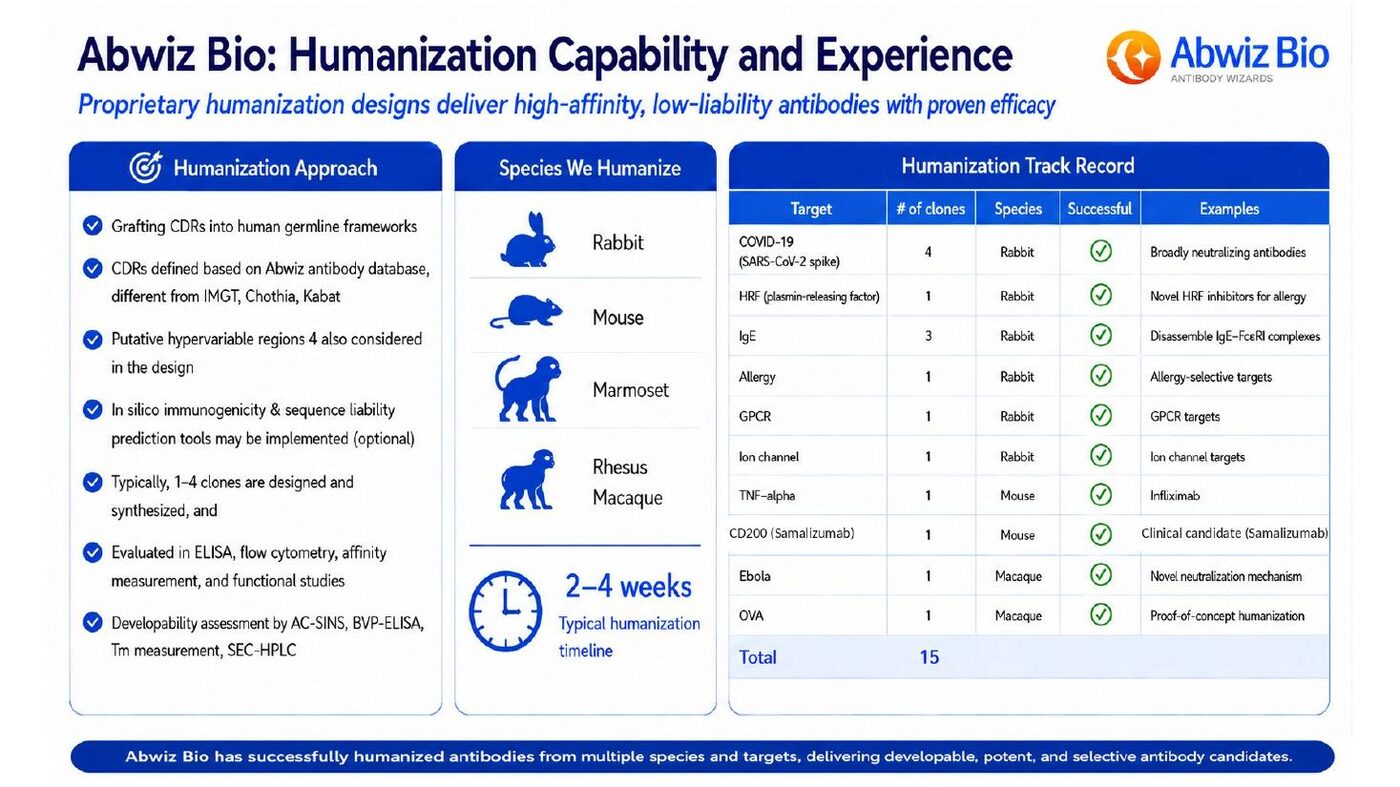
CDRs are grafted into human germline frameworks using CDR definitions derived from the Abwiz antibody database rather than IMGT, Chothia or Kabat alone, with hypervariable region 4 also considered in the design. Typical turnaround is 2–4 weeks. Fifteen of fifteen programs across rabbit, mouse and macaque parents — spanning SARS-CoV-2, HRF, IgE, GPCR, ion channel, TNF-alpha, CD200 and Ebola targets — produced successful humanized candidates.
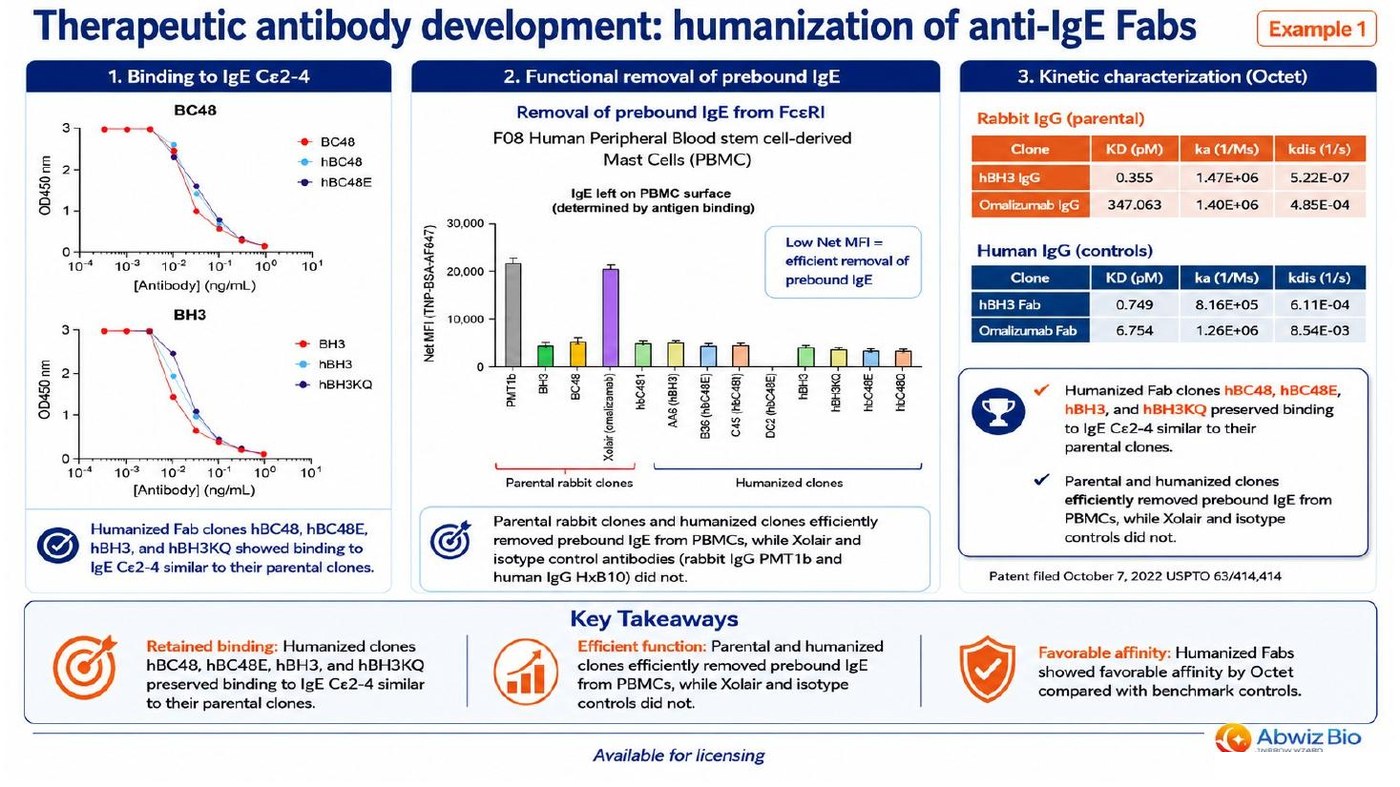
Humanized anti-IgE Fabs retain parental binding and function
Humanized clones hBC48, hBC48E, hBH3 and hBH3KQ preserved binding to IgE Cε2-4 at levels comparable to their parental rabbit clones. Both parental and humanized clones efficiently removed pre-bound IgE from human peripheral blood-derived mast cells, while omalizumab and isotype controls did not. Octet kinetics gave a 0.355 pM KD for hBH3 IgG. Patent filed October 7, 2022 (USPTO 63/414,414). Available for licensing.
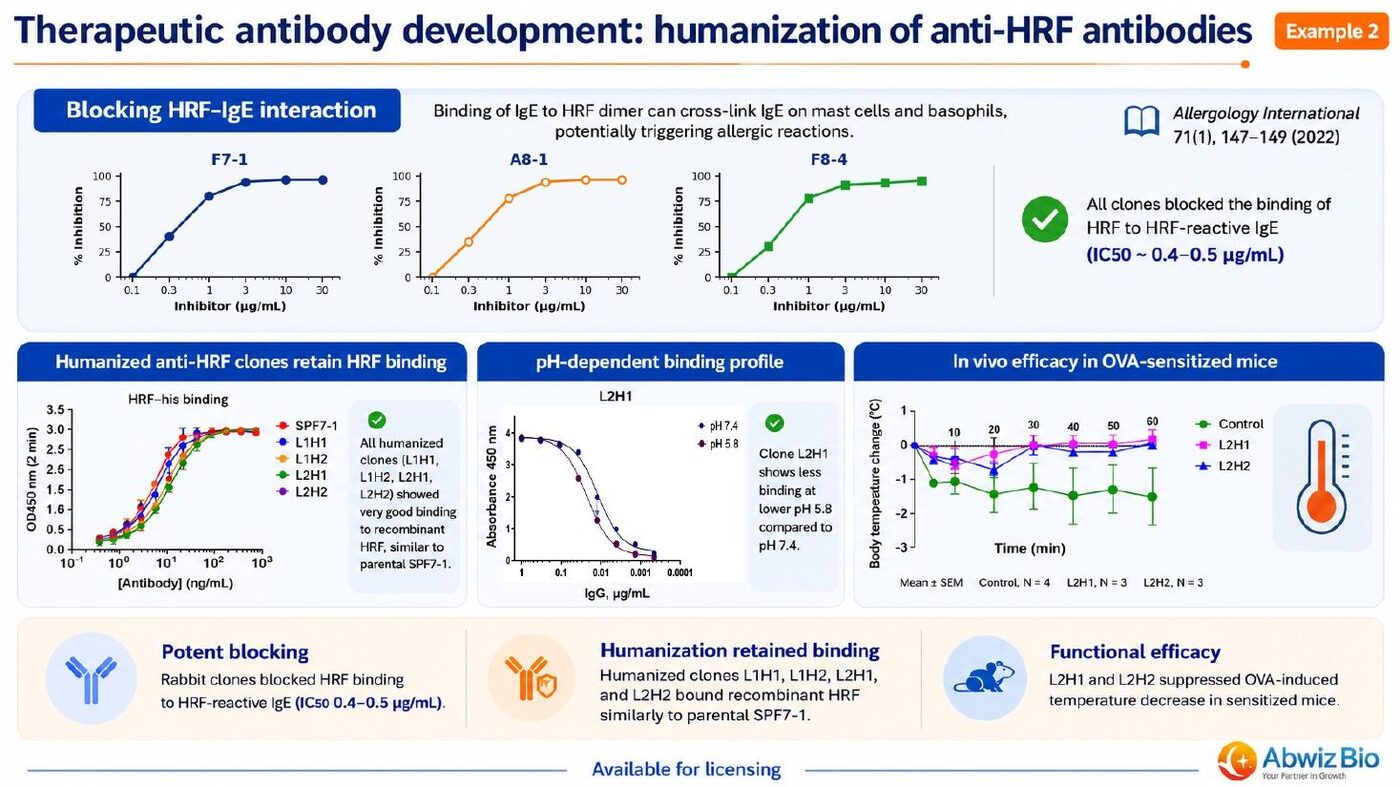
Humanized anti-HRF clones block HRF–IgE interaction and show in vivo efficacy
Rabbit clones blocked HRF binding to HRF-reactive IgE with IC50 around 0.4–0.5 µg/mL. Humanized clones L1H1, L1H2, L2H1 and L2H2 bound recombinant HRF similarly to the parental SPF7-1, and L2H1 showed reduced binding at pH 5.8 versus pH 7.4. In OVA-sensitized mice, L2H1 and L2H2 suppressed the OVA-induced temperature drop. Available for licensing.
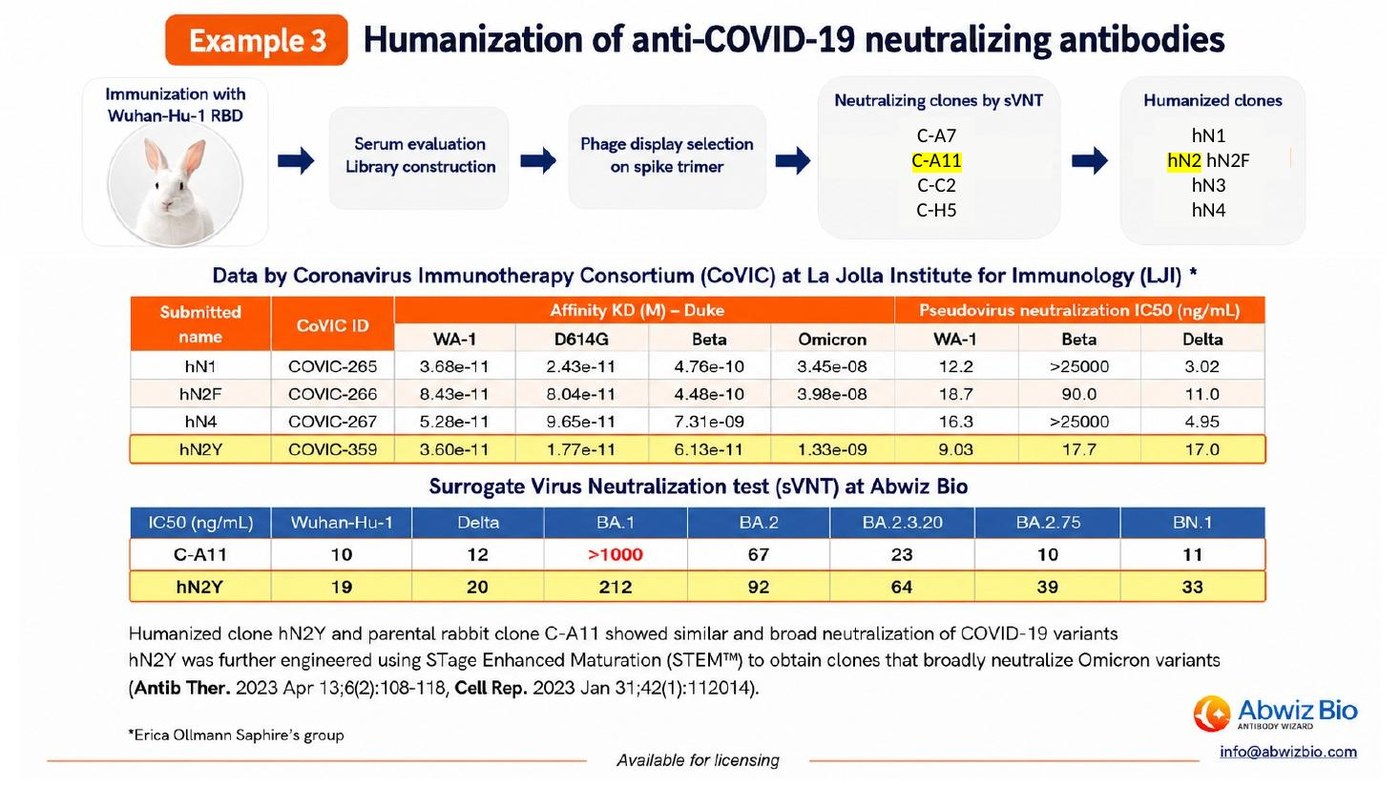
Humanized anti-COVID-19 neutralizing clones match the parental rabbit antibody
Rabbit immunization with Wuhan-Hu-1 RBD followed by phage-display selection on spike trimer produced neutralizing clones that were then humanized. Humanized clone hN2Y and its parental rabbit clone C-A11 showed similar broad neutralization across variants, and hN2Y was subsequently engineered with STEM™ to broadly neutralize Omicron strains. Affinity and pseudovirus neutralization data were generated by the Coronavirus Immunotherapy Consortium at the La Jolla Institute for Immunology.
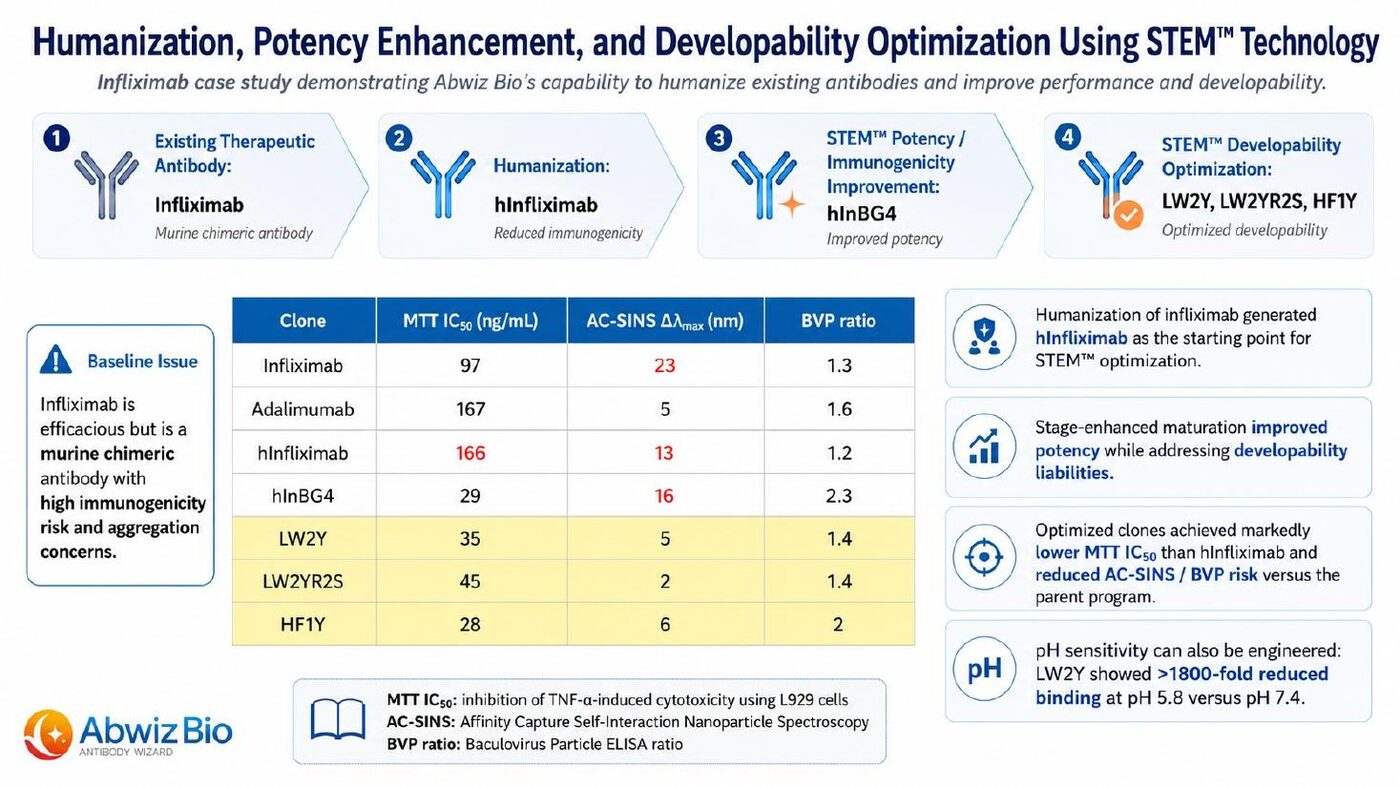
Humanization followed by STEM™ potency and developability optimization
Infliximab, a murine chimeric antibody with immunogenicity and aggregation concerns, was humanized to hInfliximab and then optimized with STEM™. Optimized clones LW2Y, LW2YR2S and HF1Y reached MTT IC50 values of 28–45 ng/mL versus 166 ng/mL for hInfliximab, with lower AC-SINS shifts and reduced BVP ratios. LW2Y additionally dissociated more than 1,800-fold faster at pH 5.8 than at pH 7.4, the signature of pH-dependent antigen release. Full data are in the preprint: doi:10.64898/2026.08.18.745573 (bioRxiv, 2026 — preprint, not peer reviewed).
Timeline and deliverables
The timelines below are typical durations from signed PO to delivery for a single antibody humanization program. Sponsors with multiple parental clones in parallel often see modest economies in shared milestones.
| Engagement | Typical timeline | Outcome |
|---|---|---|
| Standard humanization (parental sequence in hand → humanized panel) | 8–12 weeks | 5–10 humanized variants expressed and binding-characterized; one recommended lead with rationale |
| Humanization from hybridoma (RNA isolation → humanized panel) | 10–14 weeks | Adds parental sequencing, mass-spec confirmation, and re-baselined binding before humanization |
| Humanization + STEM™ affinity maturation | 14–18 weeks | Humanized panel plus matured leads on the human framework background; documented affinity gain |
| Legacy program revival (re-sequencing + humanization) | 12–16 weeks | Re-baselined parental dataset plus humanized panel; IND-ready documentation package |
Standard deliverables on every humanization engagement
- Parental VH and VL sequence files (FASTA, GenBank, and annotated CDR / framework map by both Kabat and IMGT)
- Homology model of the parental Fv with vernier residues and framework-CDR contacts annotated
- Framework selection memo with germline-similarity scoring and rationale for the selected human framework
- Humanized panel sequences (5 to 10 variants) with back-mutation map for each variant
- Expression data: transient expression yields, monomer content by SEC, purity by SDS-PAGE
- Binding data: KD measurement on every humanized variant against the same antigen and assay as the parental control
- In silico immunogenicity prediction across HLA-DR allele panel for every variant
- Developability assessment: aggregation hotspots, deamidation / isomerization motifs, glycosylation sites, charge clusters
- Recommended lead variant with written rationale that integrates affinity, immunogenicity prediction, and developability
IP terms and engagement structure
Abwiz Bio offers humanization on terms designed to fit the sponsor’s development model. Fee-for-service options are available, with royalty-free terms on most engagements; downstream economics on certain programs are agreed by mutual agreement at scoping. A standard service agreement is available on request and can be reviewed by your legal team before the technical scoping discussion concludes.
For sponsors who require a specific IP structure — for example, an academic licensing pathway, a virtual-biotech milestone-based structure, or a pharma master service agreement — we adapt the contract framework to match. The scoping conversation makes the IP structure explicit early so the technical scope and the commercial scope are agreed in parallel rather than sequentially. There are no mandatory downstream royalty terms imposed at the platform level.
For sponsors who have not previously worked with a humanization CRO, the Buyer’s Checklist (PDF) includes a contract-terms section that frames the questions to ask any CRO — not only Abwiz — so the comparison across vendors is on a like-for-like basis.
Why sponsors choose Abwiz Bio for humanization
The decision drivers we hear in scoping conversations are consistent across pharma and biotech sponsors.
- Specialist workflow, not a templated checkbox. Per-program judgment calls on CDR scheme, vernier retention, and framework selection — not a one-shape-fits-all graft.
- Scientist-led scoping. Every scoping conversation is with a PhD scientist who will run the work, not a sales handoff.
- Documented 15-for-15 single-pass success. Every humanization campaign run to date has produced a usable humanized lead in the first design pass.
- STEM™ affinity maturation available as an integrated phase for programs that need picomolar binding on the human framework background.
- Combined discovery-plus-humanization on one platform for sponsors who want a single-CRO path from antigen to humanized lead. See the upstream rabbit monoclonal antibody development service.
- Patented library technology backs the upstream discovery. The WizAmp™ library construction process is our own IP — see the WizAmp™ patent page.
- IND-defendable documentation. Framework selection memo, back-mutation map, and developability dossier ship as standard deliverables so the humanization story is regulator-ready.
- San Diego antibody CRO operating since 2012. Tough-target antibody engineering is the reason Abwiz exists — humanization, affinity maturation, and discovery on hard targets.
Frequently asked questions
What is the difference between humanization and chimerization?
Chimerization fuses a non-human variable region to a human constant region — the Fab is still mouse or rabbit, only the Fc is human. Humanization replaces the framework of the variable region itself with a human germline, keeping only the parental CDRs. Chimerics retain more parental sequence and so retain affinity more reliably, but they also retain more immunogenicity and routinely raise anti-drug antibodies in the clinic. Humanization is the modern standard for therapeutic candidates. Chimerization is occasionally used as a tactical intermediate — for example, as a benchmarking control to confirm that affinity is preserved across the constant-region swap before the variable-region engineering begins.
Will humanization reduce affinity?
Sometimes, modestly, and almost always recoverably. On the humanized variants we deliver, the median affinity is within a factor of two of the parental in the same assay, and on most programs at least one variant in the panel matches the parental binding within experimental noise. When the most-human variant in the panel does drop affinity by a larger factor, a more conservative variant in the same panel typically recovers it. When the program needs to exceed parental affinity rather than merely retain it, STEM™ maturation on the humanized framework is the answer — documented improvements exceed 1,300-fold on programs where deep paratope engagement was available.
Can you humanize a mouse hybridoma clone?
Yes. The standard engagement for a hybridoma-origin parental adds a phase 0 in which we re-sequence the parental VH and VL from hybridoma RNA, confirm authenticity by mass spectrometry of the parental IgG, and re-baseline the binding data on a fresh recombinant expression. The re-baselining is important because legacy hybridoma binding data are often from polyclonal supernatants or contain low-level light-chain artifacts, and humanization on an incorrect parental sequence is a common source of downstream confusion. Once the parental is confirmed, the humanization workflow runs as standard.
Do you offer humanization without prior discovery work?
Yes. Humanization is offered as a stand-alone service for sponsors who have a parental antibody in hand — from an academic collaborator, an internal program, a prior CRO engagement, or a licensed asset. The engagement starts at parental sequence confirmation and ends at a recommended humanized lead with full documentation. Sponsors who also want discovery on a different target frequently bundle the two engagements, but humanization does not require an Abwiz-discovered parental.
What developability filters do you apply?
The standard developability assessment is run on every humanized variant before expression. It covers predicted aggregation hotspots from the homology model, unpaired cysteines and free thiols in the variable region, deamidation motifs (NG, NS) and isomerization motifs (DG, DS) in the CDRs, N-linked glycosylation sites in the CDRs, charge clusters and predicted isoelectric point, and predicted hydrophobic patches. Variants that fail any filter are flagged with a recommended repair or dropped from the panel. The developability dossier is included in the standard deliverables.
How do you handle long CDR-H3 loops?
A long CDR-H3 (greater than 18 residues by Kabat) is a feature, not a defect — it often drives the parental affinity. The risk in humanization is that the human framework selected does not provide the canonical-structure support the long loop needs. Our default is to select the framework using canonical-structure compatibility scoring rather than sequence similarity alone, and to retain the vernier residues that pack against the loop base in the conservative humanized variants. On rabbit-origin antibodies with unusually long CDR-H3, this is one of the per-program design calls we make explicitly during the framework selection memo.
Can you humanize while also doing affinity maturation?
Yes — this is the standard combined engagement when the program needs picomolar binding on the human framework. We humanize first, identify the recommended humanized lead, then run STEM™ affinity maturation on that lead. The maturation happens on the sequence the sponsor will actually file, which avoids the affinity-loss surprise that occurs when sponsors mature on the parental and humanize afterward. The combined workflow typically takes 14 to 18 weeks. Documented maturation improvements have exceeded 1,300-fold on amenable targets, with the tightest delivered apparent KD at 4.4 pM by Octet.
What is the typical retention rate of parental affinity?
Within the humanized panel we deliver on each program (5 to 10 variants), the rate at which at least one variant retains 80% or more of parental affinity is, to date, 15 out of 15 programs. The median per-variant retention across the panel is closer to two-thirds of variants meeting that threshold, with the distribution shifted toward the conservative-back-mutation end. We share the per-variant retention data with the sponsor at the panel-readout gate so the lead selection decision is data-driven rather than statistical.
Working a humanization project?
Tell us about the parental antibody, the species of origin, and the target product profile. A scientist will reply within one business day with our approach — not a sales pitch.
Free 30-minute call with the PhD scientist who would run the work · Initial feasibility assessment within two business days · NDA available before you disclose your target
Related Abwiz Bio resources
- All 22 antibody services — rabbit phage display, WizAmp™ library construction, STEM™ affinity maturation
- WizAmp™ library construction patent (US 9,890,414) — the patented library technology that backs upstream discovery
- Custom rabbit monoclonal antibody development — the upstream discovery service most commonly paired with humanization
- Publications and case studies — peer-reviewed work documenting the discovery and engineering platform
- CRO Buyer’s Checklist (PDF) — a vendor-neutral scoring framework for evaluating humanization and discovery CROs
- Email a scientist — direct technical scoping with the PhD who will run your program