
Case Studies
Featured Case Studies
Making Infliximab More Potent and More Developable
Internal benchmark programme • Anti-TNFα • Human IgG1
Challenge
Infliximab is clinically validated but biophysically awkward: a mouse–human chimera with documented Fab–Fab self-association and a requirement for prolonged intravenous infusion. We ran it as an internal benchmark precisely because it is a molecule that would not flatter the platform.
STEM™ Approach
CDRs were grafted onto human germline frameworks (IGKV6-21 / IGHV3-72). STEM™ maturation produced hInBG4, which recovered potency — but developability profiling showed it had inherited the parental self-association (AC-SINS 9.00 nm). Targeted CDR substitution on that scaffold then removed the liability without giving the potency back.
Results
The lead, LW2Y, neutralized TNFα 2.8× more potently than chimeric infliximab and 4.8× more potently than adalimumab, self-associated less than either, expressed better, and released antigen at endosomal pH. Full data are public.
Project Details
- Starting IC50: 96.8 ng/mL (chimeric infliximab)
- Final IC50: 34.5 ng/mL (LW2Y)
- Stages: Humanization → Stage 1 → Stage 2 → targeted substitution
- Species: Humanized (human IgG1)
- Validation: Cell-based MTT, AC-SINS, BVP ELISA, SE-HPLC, Octet BLI
- Outcome: Preprint published — doi:10.64898/2026.08.18.745573
Achieving Picomolar Affinity from a Nanomolar Lead
Therapeutic mAb • Oncology Target • Human IgG
Challenge
A client’s lead therapeutic antibody showed promising target specificity but insufficient binding affinity (5.9 nM apparent KD) for the desired clinical application. Previous optimization attempts using CDR walking had yielded only modest 2-3× improvements.
STEM™ Approach
We ran the full STEM™ workflow. Stage 1 diversified each CDR as a separate library and then recombined the light- and heavy-chain pools under stringent selection; Stage 2 combined the surviving variants into a single full combination library. Total library complexity was held within the electroporation capacity of roughly 1 × 10¹⁰ cfu, with heat challenge and polyreactivity counter-selection at every round.
Results
The top engineered candidate achieved a 1,338-fold improvement to 4.4 pM apparent KD, measured in-house by Octet biolayer interferometry. The final clone retained full target specificity and was patented for therapeutic use.
Project Details
- Starting Affinity: 5,890 pM (5.9 nM) apparent KD
- Final Affinity: 4.4 pM apparent KD
- Stages: Stage 1 → Stage 2 (full STEM™)
- Species: Felinized
- Validation: Octet (BLI), apparent KD
- Timeline: ~5 months
- Outcome: Therapeutic patent filed
Rescuing a Poorly-Expressing Therapeutic Lead
Therapeutic mAb • Cell-Surface Target • Human IgG
Challenge
A client antibody showed excellent functional activity in cell-based assays but critically poor expression yield, creating a manufacturability bottleneck that threatened the program’s clinical viability.
STEM™ Approach
Using only cells natively expressing the target antigen, STEM™ selected for clones retaining function while improving expression. Libraries were transiently heated to remove unstable clones, then subtracted on polyspecificity reagents before positive selection on antigen-expressing cells. Filter stringency was increased at each stage.
Results
Engineered clones showed >10-fold improved expression with equivalent functional activity in cell assays. Stability and polyreactivity profiles were significantly improved. A therapeutic patent was filed on the final candidates.
Project Details
- Goal: Improve expression
- Selection: Cell-based panning
- Filters: Thermostability + polyreactivity
- Expression Gain: >10-fold
- Function: Maintained
- Outcome: Patent filed
Engineering pH-Dependent Binding for Enhanced Recycling
Biobetter Program • Anti-Cytokine Target • Human IgG
Challenge
A program required antibodies with strong target binding at physiological pH 7.4 but rapid release at endosomal pH 5.8, enabling efficient antibody recycling for enhanced potency and extended half-life. The parent antibody showed negligible pH sensitivity.
STEM™ Approach
All three stages of STEM™ were performed with dual-pH selection: high affinity binding at pH 7.4 combined with release screening at pH 5.8. Libraries were designed to introduce pH-sensitive histidine substitutions at key CDR positions while maintaining overall structural integrity.
Results
While the parent antibodies showed negligible pH sensitivity, the STEM™-engineered clones achieved rapid dissociation under mildly acidic conditions while retaining high-affinity binding at physiological pH — enabling efficient endosomal recycling for improved therapeutic potency.
Project Details
- Goal: Engineer pH sensitivity
- Mechanism: Endosome recycling
- Selection pH: 7.4 / 5.8
- Stages: Full STEM™ (A1→A2→B)
- Validation: BLI (Octet)
- Outcome: Biobetter candidates advanced
Avidity Engineering for Optimal Functional Activity
Fab Engineering • Multi-Format Screening • Affinity Range
Challenge
For certain therapeutic formats — such as single-chain TCRs, CARs, or agonistic/antagonistic antibodies — extremely high affinity binding may not be optimal. This project required generating a panel of variants with precisely tuned on-rates and off-rates to identify the ideal binding kinetics for maximal functional activity.
STEM™ Approach
In Stage 1, single-CDR variant libraries were selected under mild conditions to remove non-productive clones. The Stage 2 combined library was then subjected to multiple selection conditions including all combinations of fast/slow on-rates and off-rates. Candidates were screened by both monovalent ELISA (true affinity) and bivalent pseudo-IgG ELISA (avidity).
Results
A panel of engineered clones with a broad range of binding affinities was successfully generated. Both high-affinity and weakly-binding, high-avidity variants were obtained, enabling identification of the optimal kinetic profile for the intended therapeutic application.
Project Details
- Goal: Kinetic tuning panel
- Format: Fab-based engineering
- Selection: Multi-condition panning
- Screening: Monovalent + bivalent ELISA
- Outcome: Kinetic variants for functional screening
Published Data
Peer-reviewed results from Abwiz Bio discovery and engineering programs, published in Cell Reports, Antibody Therapeutics, the Journal of Biological Chemistry and the Journal of Allergy and Clinical Immunology. Click any figure to view it full size.
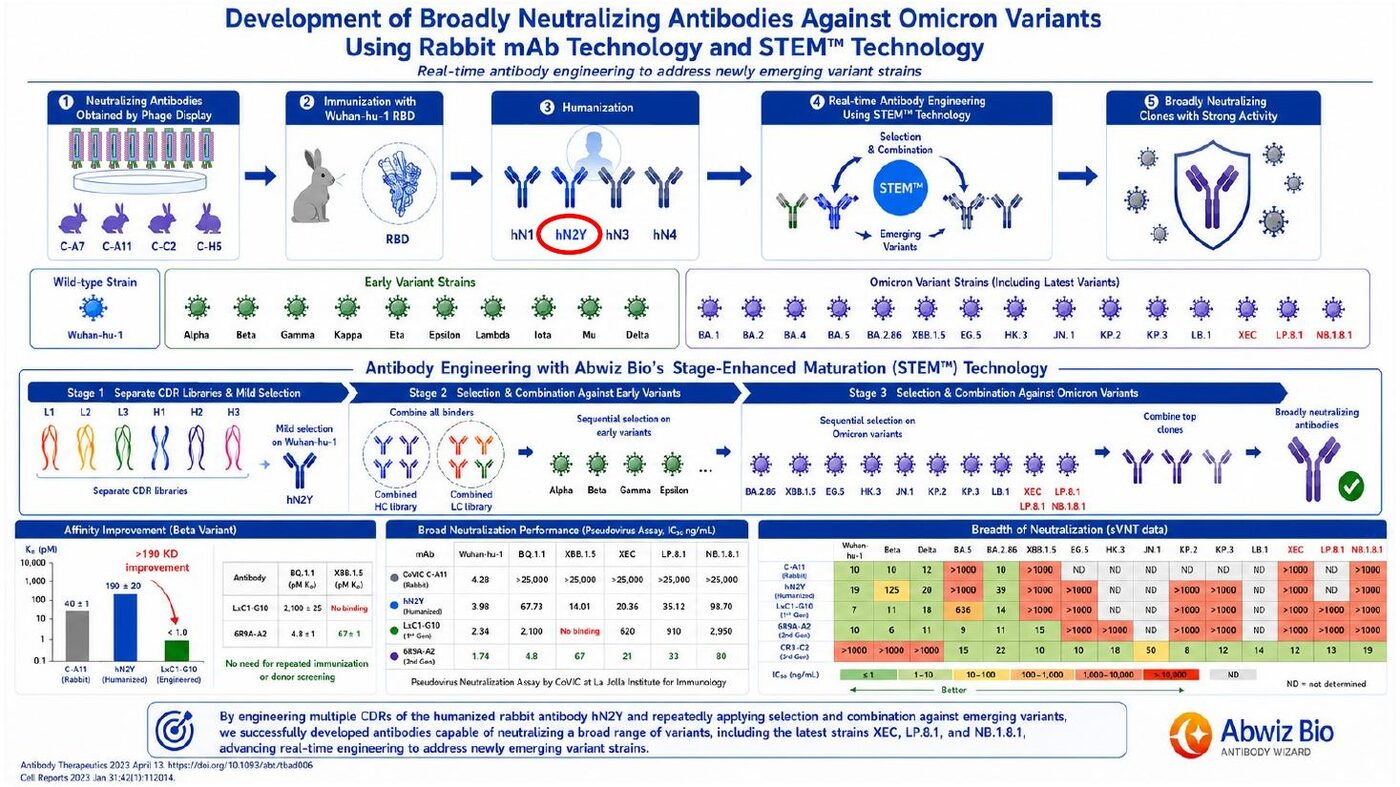
Broadly neutralizing antibodies against Omicron variants using rabbit mAb and STEM™ technology
A rabbit monoclonal lead was humanized and then matured with STEM™ through successive rounds of selection and combination against emerging variants. The engineered clone gained a >190× affinity improvement over the humanized parent and neutralized strains from Wuhan-Hu-1 through the latest XEC, LP.8.1 and NB.1.8.1 variants.
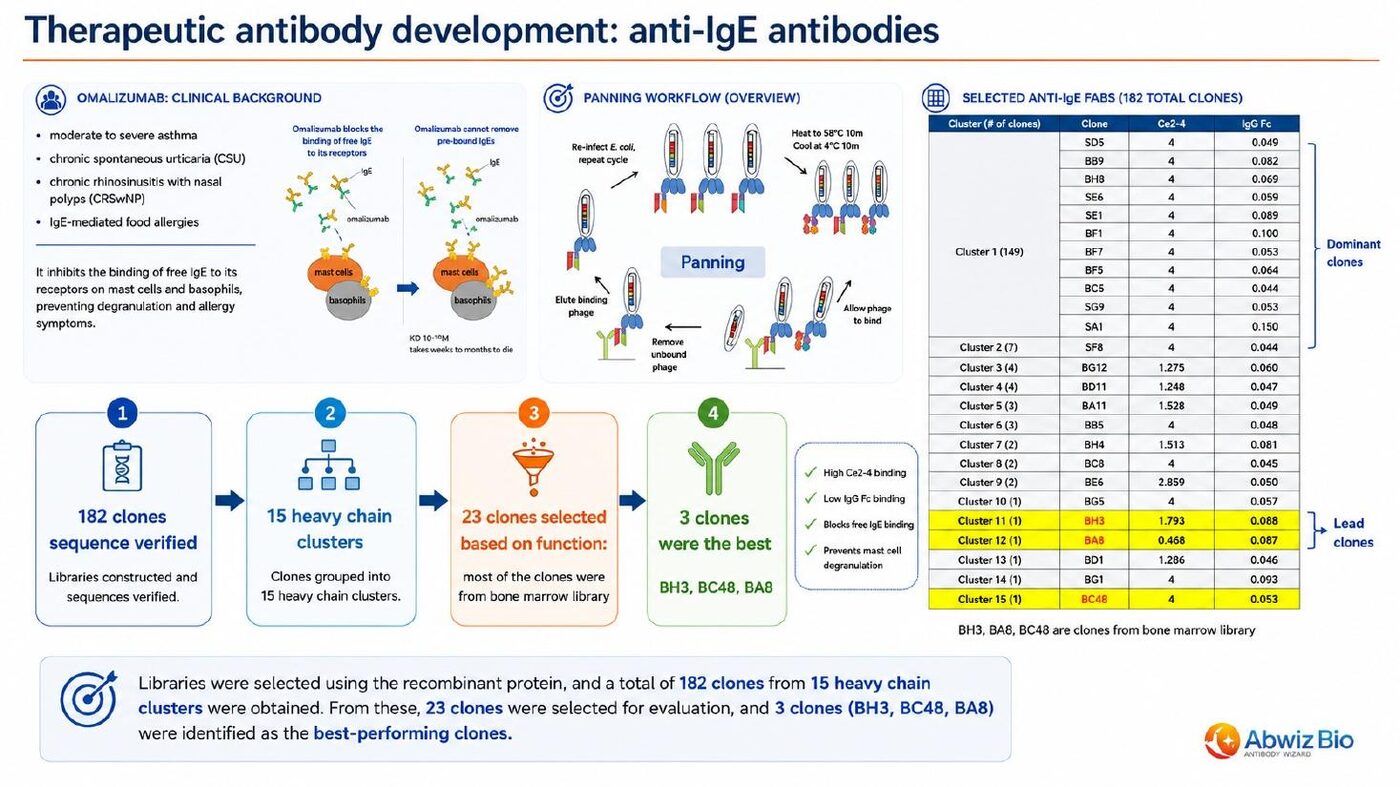
Anti-IgE Fab discovery: 182 sequence-verified clones narrowed to three functional leads
Immune Fab libraries were panned against recombinant IgE and 182 sequence-verified clones were recovered across 15 heavy-chain clusters. Functional triage of 23 candidates identified three best-performing clones — BH3, BC48 and BA8 — all originating from the bone marrow library.
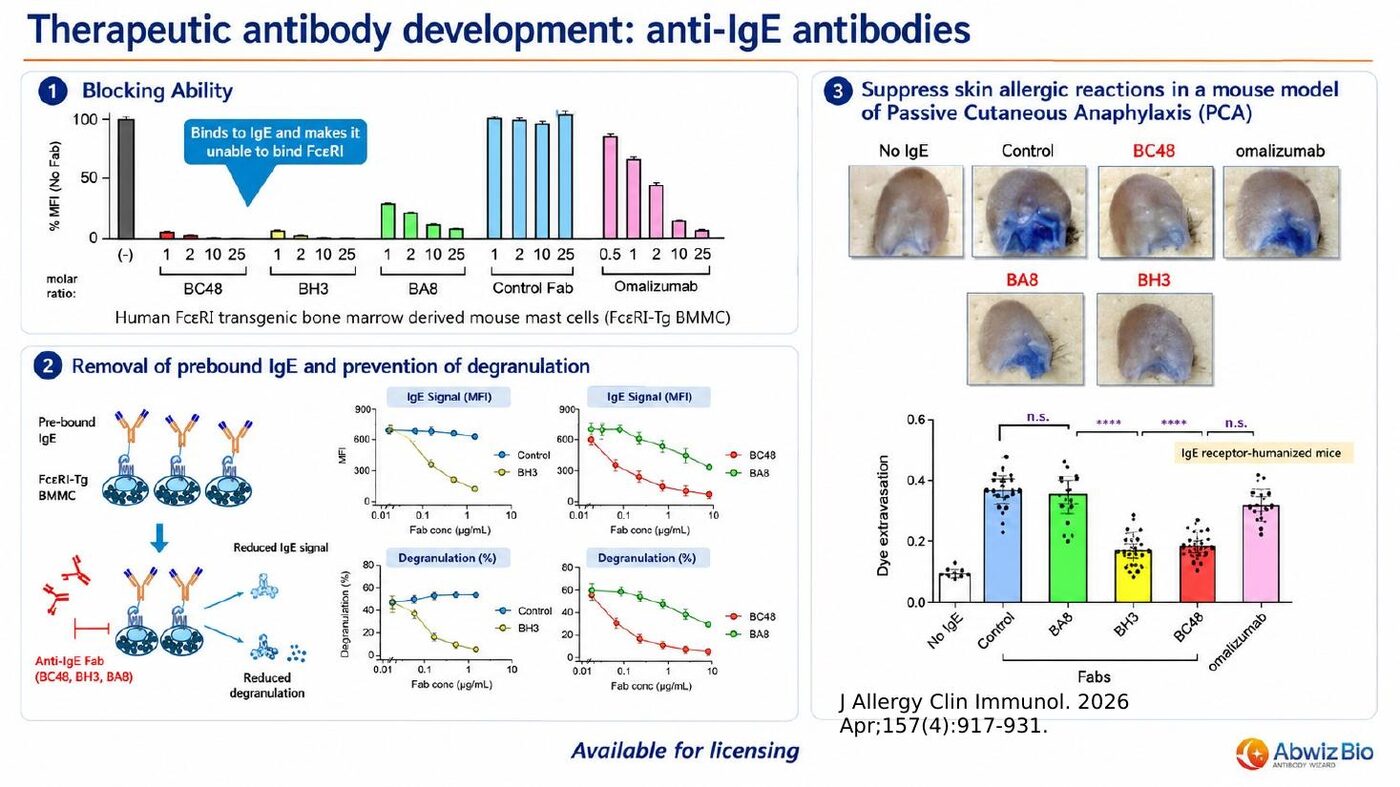
Anti-IgE leads block FcεRI binding, strip pre-bound IgE and suppress anaphylaxis in vivo
The three leads blocked IgE binding to FcεRI at low molar ratios, removed pre-bound IgE from FcεRI-transgenic mast cells and reduced degranulation. In IgE receptor-humanized mice, BH3 and BC48 significantly suppressed passive cutaneous anaphylaxis where omalizumab did not. These antibodies are available for licensing.
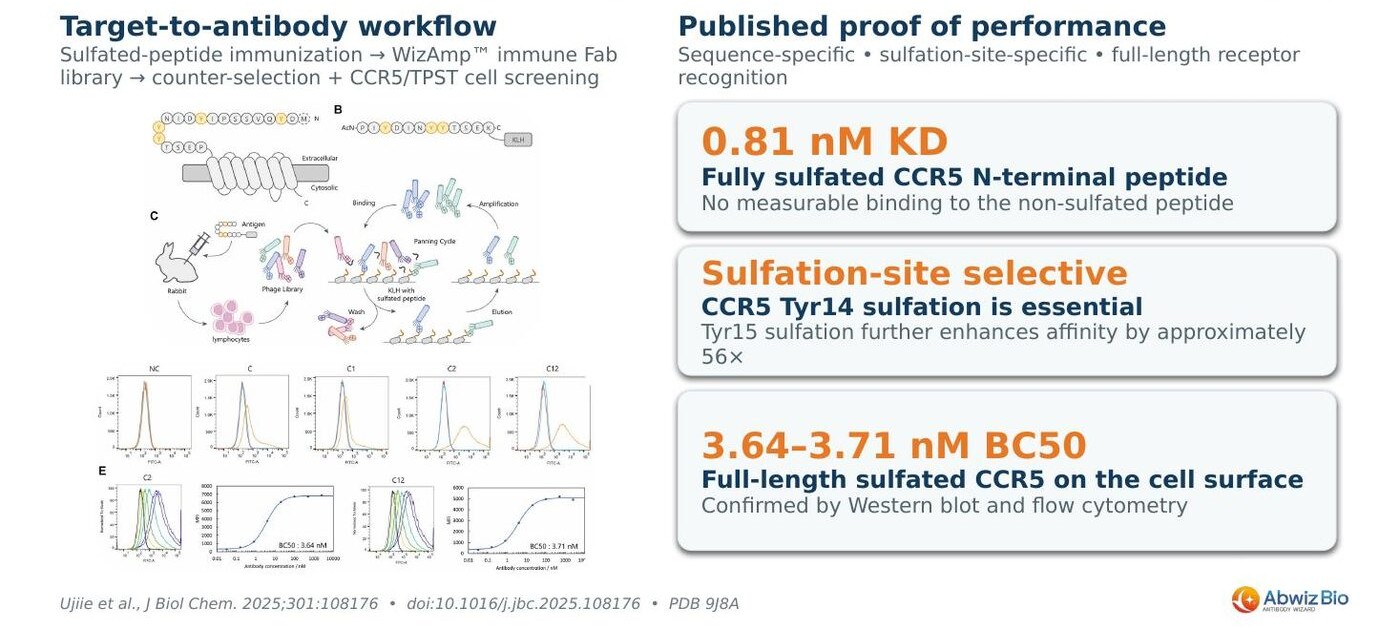
Site-specific antibodies against the sulfated CCR5 N-terminus
Sulfated-peptide immunization feeding a WizAmp™ immune Fab library, combined with counter-selection and CCR5/TPST cell screening, produced an antibody that discriminates both sulfation state and sulfation site. It bound the fully sulfated CCR5 N-terminal peptide at 0.81 nM KD with no measurable binding to the non-sulfated peptide, and recognized full-length sulfated CCR5 on the cell surface at 3.64–3.71 nM BC50.
Peer-Reviewed Publications
Our STEM™ platform results have been validated in peer-reviewed journals including Cell Reports, Antibody Therapeutics, and the Journal of Biological Chemistry. Our published work on engineering broadly-neutralizing therapeutic antibodies demonstrates the platform’s ability to iteratively improve both affinity and breadth of activity across rapidly evolving targets.
Ready to See What STEM™ Can Do for Your Program?
Our scientists have optimized antibodies against dozens of therapeutic targets across multiple species and formats. Let us design a custom engineering strategy for your lead candidates.
Request a Consultation →